Who Still Pays for Classifieds?
Over at Recordonline.com, the site of my former employer the Times Herald Record, it still says this under the 'place your own classified ad' link: "7 days-5 lines, $42.45." My question is a simple one: "Who still does this and why?"
I was at the Interactive Local Media conference in VA last week where I met a woman who works for a company that hosts papers' sites and/or classifieds, including the classifieds for the Record. I shared with her the following experience. While living in Oakland, CA, I was trying to sell my '91 Honda Accord. At the time, I worked for the Contra Costa Times.
Taking advantage of those bountiful newspaper industry perks, I placed a free classified (others paid fifty-something bucks, I think) in the paper. It also ran on the Web site and that of the Mercury News, covering a good chunk of the Bay Area and beyond. The first morning the ad ran, I arrived at work, there were three voicemails from some crazy Chinese guy screaming into the phone that I had to sell him the car and to do otherwise was proof that I was a "silly American." It was weeks before this guy finally stopped calling.
The second call came from a guy who was also selling an Accord through the paper and was just wondering if I'd had any bites. He hadn't. But at least the frantic Chinese guy hadn't reached him yet.
The third and final call of the ad was a guy from an auto trader-type thing who told me I was an idiot if I didn't list with him since the paper classifieds were useless. As if I hadn't already figured that out. Three calls. No sale.
Put a free ad on Craigslist and sold the car in two days.
After moving to Hudson Valley, I thought I'd have to go through the same thing. Ran my complimentary ad and got zero responses. Almost made me miss the Chinese guy. Almost. See, I knew Craigslist ruled, but I wasn't in New York City and Craig wasn't upstate. But it's free, so why not? Sold that car and another later, each to people outside NYC who nonetheless used Craig's NYC list.
Now add Google Base, LiveDeal, Oodle, even MySpace, and you have to wonder: Who still pays for classifieds? Whoever they are, they're giving newspapers the foolish idea that this is a sustainable business model.
#
Tuesday, December 06, 2005


Wednesday, November 09, 2005
The Original Pop-Up A
The Original Pop-Up Ad
Pop-up ads didn’t start with the Web. Magazines invented this form of annoying their readers. Talking here about the dozen subscription cards that I had to tear out of the latest issue of Smart Money. Five were for the magazine itself, the rest for advt’r promotions. Does anyone actually tear/fill/send out those “more information” cards? As for the house sub cards, if I like the magazine enough, I’ll make the effort to subscribe. They’re obviously hoping to beat readers into submission, but of course, unlike subscribing to a Web site, that won’t save you from future pitches to join up.
Pop-up ads didn’t start with the Web. Magazines invented this form of annoying their readers. Talking here about the dozen subscription cards that I had to tear out of the latest issue of Smart Money. Five were for the magazine itself, the rest for advt’r promotions. Does anyone actually tear/fill/send out those “more information” cards? As for the house sub cards, if I like the magazine enough, I’ll make the effort to subscribe. They’re obviously hoping to beat readers into submission, but of course, unlike subscribing to a Web site, that won’t save you from future pitches to join up.
Tuesday, November 08, 2005
Green Party Political Pollution
It's election day. The campaign signs used to be clustered at intersections, now they seem to extend all the way down every major (and several minor) roads in town.
It's protected political speech, yes, and I was part of the phenomenon myself as a youngin helping rally votes for Mayor Mom. But this is getting out of hand. The more signs that go up, the longer it takes for them to come down.
So much visual pollution. And the worst offender? Why it's the Green Party, of course.
It's election day. The campaign signs used to be clustered at intersections, now they seem to extend all the way down every major (and several minor) roads in town.
It's protected political speech, yes, and I was part of the phenomenon myself as a youngin helping rally votes for Mayor Mom. But this is getting out of hand. The more signs that go up, the longer it takes for them to come down.
So much visual pollution. And the worst offender? Why it's the Green Party, of course.
Tuesday, November 01, 2005
Corporations Think You're Stupid.
Gee, why do people have a hard time trusting giant corporations? Maybe because of moves like this. What more cynical move is there then to hop on the organic food band wagon because of its growing popularity and than try to undermine the whole movement by trying to change the whole meaning of organic. The big food cos. have been buying up organic brands by the dozen to capture their growth. But instead of continuing to deliver what customers want, the cos. want to pervert the whole thing by injecting synthetics into these products while still calling them "organic."
So organic is just a brand, a way to sucker consumers, while these manufacturers continue to do business the same old way...the way consumers are trying to move beyond in the first place. Trouble is, big corporations are always refuge's for tired old thinkers who rely on their money and political connections to compensate for an inability and unwillingness to simply deal openly and honestly with the market.
I suspect this will backfire in the end. Sure, they'll sell stuff to people who take comfort in a word on a box (just like they did with "no cal" and "no carb"). But the whole organic movement started with people who took the time to flip the package over and read the fine print. These folks are too savvy to be suckered by the likes of General Mills and they'll lead the way for small companies that want to stay true to what it means to be organic.
Gee, why do people have a hard time trusting giant corporations? Maybe because of moves like this. What more cynical move is there then to hop on the organic food band wagon because of its growing popularity and than try to undermine the whole movement by trying to change the whole meaning of organic. The big food cos. have been buying up organic brands by the dozen to capture their growth. But instead of continuing to deliver what customers want, the cos. want to pervert the whole thing by injecting synthetics into these products while still calling them "organic."
So organic is just a brand, a way to sucker consumers, while these manufacturers continue to do business the same old way...the way consumers are trying to move beyond in the first place. Trouble is, big corporations are always refuge's for tired old thinkers who rely on their money and political connections to compensate for an inability and unwillingness to simply deal openly and honestly with the market.
I suspect this will backfire in the end. Sure, they'll sell stuff to people who take comfort in a word on a box (just like they did with "no cal" and "no carb"). But the whole organic movement started with people who took the time to flip the package over and read the fine print. These folks are too savvy to be suckered by the likes of General Mills and they'll lead the way for small companies that want to stay true to what it means to be organic.
Tuesday, October 25, 2005
What Ever Gave Us Silly NYT Readers That Impression?

I was looking at this graf in particular in the New York Times piece from a week
ago Sunday in which it looked at its/Judy Miller's involvement in the Plame affair
(I like to avoid "gate" suffix and/or the more unbearable "l'affair Plame"):

In August, Douglas Jehl and David Johnston, two other Washington reporters,
sent a memo to the Washington bureau chief, Mr. Taubman, listing ideas for
coverage of the case. Mr. Taubman said Mr. Keller did not want them pursued because
of the risk of provoking Mr. Fitzgerald or exposing Mr. Libby while Ms. Miller was
in jail.

Juxtapose that with Keller's statement that:

"...I fear I fostered an IMPRESSION (emphasis mine) that The Times put a higher
premium on protecting its reporters than on coming clean with its readers."

This undermines the sincerity of Keller's mea culpa. Readers got that IMPRESSION
because, at least in  that one instance, there's no denying that he DID put the
interests of Miller and the NYT ahead of those of its readers.

Why can't anyone just apologize straight-up anymore? No one is fooled by this
hemming and hawing.
Who Will Michiko be Today?
First, Michiko Kakutani channeled Holden Caufield for a review of Benjamin Kunkel's "Indecision." Now she's Holly Golightly reviewing the "new" Capote book, "Summer Crossing." She's been at this for a while. Is she bored?
First, Michiko Kakutani channeled Holden Caufield for a review of Benjamin Kunkel's "Indecision." Now she's Holly Golightly reviewing the "new" Capote book, "Summer Crossing." She's been at this for a while. Is she bored?
Tuesday, October 18, 2005
Monday, October 17, 2005
Not to NYT: Serve Your Readers, Not Yourselves
- What I took away from the package:
1) When push comes to shove, the New York Times will
put its own interests above those of its readers.
(Reporters pushed ideas for covering the story and
Keller shot them down).
2) Equivocating aside, Miller almost certainly lied to
her editors. (When they asked the DC bureau is anyone
was the recipient of Plame leaks).
3) What motivates Miller, I cannot say. But if
restoring her credibility was one reason for heading
to jail, this whole thing has done more harm than good
on that front. She said she discussed
Plame/Flame/Wilson with other sources, but can't
recall who or when? Please...The first mention of
"Flame" was in the same notebook as the Libby
interview notes, but not the same section? Well, then,
what section WERE they in?
4) Keller seems like a decent guy, but there's a
willful ignorance on the part of Times management in
this thing that's inexcusable. From a reporter's
perspective, getting unqualified support from the
bosses is a beautiful thing. But again, that worked
out better for Miller than it ultimately did for the
readers. Considering this is a reporter who was at the
center of the paper's extensive (albeit soft)
"correction" for its flawed WMD reporting, Keller
would have been perfectly justified in supporting her
while ALSO pressing for more details about her
sources/interviews.
5) I won't dismiss the time she spent in jail. Maybe
she thinks it was for the greater good. But she's
pushing the martyr angle a little too hard, me thinks.
There's an example of a place more trying than that
Virginia detention center where your fellow
journalists are risking their lives to report the
news. It's called the Baghdad bureau.
Friday, October 14, 2005
You Don't Have to be a Marxist (or an Arborist) to Recognize a Root Cause
Here's the full text of a letter a sent to Romenesko yesterday in response to this piece. Apparently, I'm not the only one who took issue with it. It was a weak piece and it deserves the heat it's getting, not least because it was written by a Pulitzer Prize-winning columnist.
"Regarding Connie Schultz's piece, I too find it distressing that fewer journalism school students want careers in, well, journalism. But isn't a bit unfair for these profs to scold only students for chasing the big bucks (or at least a living wage)? Aren't they just taking their cues from the journalism business itself?
To the prof who says, 'The thought of starting out at $25,000 or $30,000 to expose corruption and champion the underdog just doesn't do it for them. They have no interest,' I'd say two thinks: 1) Starting out at $30K? Come down from your ivory tower. Many reporters (my former self included) had to get by on less than $20K to start (I started at $18K) and toiled for years before reaching $30K. Check the industry salary surveys. 2) Perhaps too many students have heard too many stories handed down from working journos whose own efforts to "expose corruption and champion the underdog" were squashed by publishers and editors who didn't share that passion and were unwilling to commit the resources or who spiked controversial stories to please an advertiser or who said, in response to a hot tip on corruption at City Hall, 'That's great, but we still need the 'cat-stuck-in-a-tree story form tomorrow's A1.'
I also despair that so few young people vote, but I put the blame largely on our screwed-up political system. Likewise, if students are turning away from hard journalism, maybe it's because too much journalism has gone soft. You reap what you sew."
I also agree with those writers who take Schultz and her sources to task for allowing anonymous hand-wringing unsupported by any hard facts to rule the column.
And, just so it's not all doom and gloom about the future of the business, the Boston Phoenix's Mark Jurkowitz has a list of journalism's up-and-comers. (Of course, let's check back in five years and see how many are in law school or at PR firms...sorry, couldn't resist).
Here's the full text of a letter a sent to Romenesko yesterday in response to this piece. Apparently, I'm not the only one who took issue with it. It was a weak piece and it deserves the heat it's getting, not least because it was written by a Pulitzer Prize-winning columnist.
"Regarding Connie Schultz's piece, I too find it distressing that fewer journalism school students want careers in, well, journalism. But isn't a bit unfair for these profs to scold only students for chasing the big bucks (or at least a living wage)? Aren't they just taking their cues from the journalism business itself?
To the prof who says, 'The thought of starting out at $25,000 or $30,000 to expose corruption and champion the underdog just doesn't do it for them. They have no interest,' I'd say two thinks: 1) Starting out at $30K? Come down from your ivory tower. Many reporters (my former self included) had to get by on less than $20K to start (I started at $18K) and toiled for years before reaching $30K. Check the industry salary surveys. 2) Perhaps too many students have heard too many stories handed down from working journos whose own efforts to "expose corruption and champion the underdog" were squashed by publishers and editors who didn't share that passion and were unwilling to commit the resources or who spiked controversial stories to please an advertiser or who said, in response to a hot tip on corruption at City Hall, 'That's great, but we still need the 'cat-stuck-in-a-tree story form tomorrow's A1.'
I also despair that so few young people vote, but I put the blame largely on our screwed-up political system. Likewise, if students are turning away from hard journalism, maybe it's because too much journalism has gone soft. You reap what you sew."
I also agree with those writers who take Schultz and her sources to task for allowing anonymous hand-wringing unsupported by any hard facts to rule the column.
And, just so it's not all doom and gloom about the future of the business, the Boston Phoenix's Mark Jurkowitz has a list of journalism's up-and-comers. (Of course, let's check back in five years and see how many are in law school or at PR firms...sorry, couldn't resist).
Tuesday, October 11, 2005
Shrinking the Paper to Grow Profits
I can't think of a better metaphor for how badly lost the newspaper business is. It's an industry that's both incapable of and unwilling to figure out how to grow profits by actually growing the newspaper (old-fashioned things like increasing readership, expanding the number of editorial and ad pages). Whether it's the quantity or size of the pages or the quality or size of the staff, the only way they know how to make more money is to cut. Doesn't make for a very bright future.
I can't think of a better metaphor for how badly lost the newspaper business is. It's an industry that's both incapable of and unwilling to figure out how to grow profits by actually growing the newspaper (old-fashioned things like increasing readership, expanding the number of editorial and ad pages). Whether it's the quantity or size of the pages or the quality or size of the staff, the only way they know how to make more money is to cut. Doesn't make for a very bright future.
Friday, October 07, 2005

The Economist Must Have all the Subscribers it Needs.
I'm having my own version of Jeff Jarvis's Dell Hellwith the bloody Economist magazine. I haven't received an issue since April. Ironically, it was the "Power at Last" issue at left which says the power of the Internet means "the consumer really is king." Online, maybe. But back here in the world of print and "service" reps, we're all apparently still nothing but a burden.
My subscription runs through Jan. '06. They have no record of me ever receiving the magazine even though I got it for a year and a half before it mysteriously stopped. The problem with their (and most) "customer service" reps is that they don't/can't/won't/aren't allowed to think for themselves. They get so wrapped up in their stock answers that they don't listen to you and they don't listen to themselves enough to realize the upsurdity of what they're saying. I'll paraphrase:
Me: So, uh, where are my issues?
Rep: We don't have any record of you in our system as ever having been a subscriber.
Me: I'll fax you a copy of the last issue with the mailing label to show you that I did, at one time, receive it.
Rep: That won't do any good.
Me: Why not?
Rep: Because if you'd received it, we'd have a record of it.
Then we did a little dance about the length of this "theoretical" subscription. I said it was for a year. "Well I don't know that," the Rep responded. "It could have been six months." Hmmm, says me, if you let me fax you this April issue with a Jan '06 expiration on the mailing label, then you can sit with it a while and figure out why that's not possible. But, still, she didn't think faxing the cover would accomplish anything.
I enjoy(ed) reading the magazine (or newspaper as it refers to itself), but not that much. So when this mess is finally resolved, it's buh bye!
Tuesday, October 04, 2005
What I want from Google Maps...
I love Google Maps' clean, sharp interface, but there's two things that I wish it would do. 1) Let me look at a street-level map, click on two points and have it show me directions/distance between the two. I realized this during a jog. I wanted to know how far I was running. I had a street corner as a reference point. More detailed than a town name, but less so than an address. But I'm out of luck. 2) When I punch in the name of a small town and returns results, I always zoom out because I want the context of the surrounding towns. But too often, by the time I've zoomed out enough to find a familiar reference point, I've lost site of the town I was searching for. Why can't Google Maps put a red pin point on the town name, just like it does on an address?
I love Google Maps' clean, sharp interface, but there's two things that I wish it would do. 1) Let me look at a street-level map, click on two points and have it show me directions/distance between the two. I realized this during a jog. I wanted to know how far I was running. I had a street corner as a reference point. More detailed than a town name, but less so than an address. But I'm out of luck. 2) When I punch in the name of a small town and returns results, I always zoom out because I want the context of the surrounding towns. But too often, by the time I've zoomed out enough to find a familiar reference point, I've lost site of the town I was searching for. Why can't Google Maps put a red pin point on the town name, just like it does on an address?
Friday, September 30, 2005
2.0 + 1.0 = none point O

This is from the site for the Web2.0 conferenece which is in San Francisco next week. I'd love to attend because 1) there's a lot of cool people talking about a lot of cool stuff and 2) I miss the Bay Area.
However, I'm pretty sure they got this quote ass backwards. Web 2.0 (blogging, social netowrink, tagging, Flickr, etc., etc.) is all about people, right?
This is from the site for the Web2.0 conferenece which is in San Francisco next week. I'd love to attend because 1) there's a lot of cool people talking about a lot of cool stuff and 2) I miss the Bay Area.
However, I'm pretty sure they got this quote ass backwards. Web 2.0 (blogging, social netowrink, tagging, Flickr, etc., etc.) is all about people, right?
Tuesday, September 27, 2005
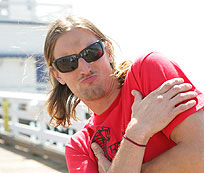 "I'm a (Yahoo! e-mail) Cowboy, Baby!"
I love Yahoo Mail, but what is this Kid Rock-wannabe doing on the home page throwing this Yo Homey! pose? This would have been a curious move even seven years ago when people were actually listening to KR. I thought the previous "art" of some woman sitting on a big blue ball while she pecked away on her laptop was silly, but at least there was some computer theme there. This guy doesn't seem to have e-mailing in mind. Maybe I should just sign in to My Yahoo and get to mail from there if this bugs me so much? Maybe later. For now, it's still worth a chuckle.
Thursday, September 22, 2005
Newspapers: Inspiring the Next Generation of Journalists
Romenesko has this NPR piece on the latest round of newspaper job cuts to hit the industry, including The New York Times and Knight Ridder's Philly papers. I particularly liked what Zack Stalberg, ex-Philadelphia Daily News editor had to say: "The youngest people in particular are thinking whether the newspaper industry is the right place for them."
Also recently, the SF Chronicle put out a call for voluntary buy outs to cut staff and got way more people raising their hands than they needed. People are rushing for the exits and those who remain are wondering if they should be celebrating or cursing that they get to keep their jobs. A similar thing happened a few years ago when I worked at the Contra Costa Times, just across the bay from San Francisco. Also a KR paper, the Times wanted to cut costs to boost profits. First it trimmed the size of the paper and told us to tell readers that it was a desire to make the paper easier to handle, not cost savings, that motivated the change. Lying to your readers is always a great way to burnish the brand of a business that relies more than almost any other on reader trust.
As I recall, they also removed the water coolers. When that didn't generate enough dough, they of course moved on to jettisoning people. They asked for "volunteers" who would accept a buyout and the response was like that of passengers on a sinking ship. And the bosses were sincerely shocked that so many people wanted to jump on the lifeboats. The most telling thing for the health, or lack thereof, of the newspaper biz was that every single person I knew who took the buyout or got so stressed out waiting to see if they'd get to take it and quit, left journalism all together, so disgusted were they with what they'd seen. There were some really talented people in the bunch. A real shame.
Romenesko has this NPR piece on the latest round of newspaper job cuts to hit the industry, including The New York Times and Knight Ridder's Philly papers. I particularly liked what Zack Stalberg, ex-Philadelphia Daily News editor had to say: "The youngest people in particular are thinking whether the newspaper industry is the right place for them."
Also recently, the SF Chronicle put out a call for voluntary buy outs to cut staff and got way more people raising their hands than they needed. People are rushing for the exits and those who remain are wondering if they should be celebrating or cursing that they get to keep their jobs. A similar thing happened a few years ago when I worked at the Contra Costa Times, just across the bay from San Francisco. Also a KR paper, the Times wanted to cut costs to boost profits. First it trimmed the size of the paper and told us to tell readers that it was a desire to make the paper easier to handle, not cost savings, that motivated the change. Lying to your readers is always a great way to burnish the brand of a business that relies more than almost any other on reader trust.
As I recall, they also removed the water coolers. When that didn't generate enough dough, they of course moved on to jettisoning people. They asked for "volunteers" who would accept a buyout and the response was like that of passengers on a sinking ship. And the bosses were sincerely shocked that so many people wanted to jump on the lifeboats. The most telling thing for the health, or lack thereof, of the newspaper biz was that every single person I knew who took the buyout or got so stressed out waiting to see if they'd get to take it and quit, left journalism all together, so disgusted were they with what they'd seen. There were some really talented people in the bunch. A real shame.
Wednesday, September 14, 2005
My List is Cooler than Your List
The New York Times had a short piece Monday on Blender's answer to the Rolling Stone's 500 greatest songs list and it caught my eye for two reasons: 1) I often listen to the RS500 channel on Rhapsody and find myself alternatelty shaking my head in disbelief ("The Kinks' Waterloo Sunset"?)or in rockin'-along satisfaction (Cheap Trick's Surrender) 2) I don't get Blender but realize I may be missing something because clearly somebody does (about 620,000 people according to circ. numbers).
The RS/Blender inter-generational pissing match aside, Blender's response seems to be a sorry solution to the baby boomer bias it sees in the RS list. I haven't seen the issue, don't even know if it's out, but apparently it will focus on the 500 greatest songs since "you" were born. Clearly they aren't talking about "me" because The Sex Pistols aren't eligible for the list, but "Best of" lists, gimmicky as the are, mean most when they draw from a deeper pool, not the shallower one Blender's swimming in. How about the 500 Best Songs since the release of Doggy Style? Of course the RS list tilts to older songs. The definition of classic is something that stands the test of time and the longer it's endured, the more of a classic it is. Twenty years from now, some of the songs from the 60's will fall away and be replaced by more New Wave and Hip Hop (and kids will wonder "Why is all this lame old hip hop on the list?"). That's the nature of the thing more than it is a generational bias.
In aiming to give its 20-something readers just what they want, Blender is forgetting that people like to argue and disagree with lists just as much as they want their particular taste affirmed. In the blog world, of course, there's been lots of discussion lately about the value or lack thereof of lists. I think one of the central points applies here as well. That is, who cares if a magazine thinks Gwen Stefani ranks higher than Coldplay? They both make music, but the similarities end there.
Jeff Jarvis asks the critical question: "This is the mass of niches. Why do we keep trying to turn it back into a mass?"
The New York Times had a short piece Monday on Blender's answer to the Rolling Stone's 500 greatest songs list and it caught my eye for two reasons: 1) I often listen to the RS500 channel on Rhapsody and find myself alternatelty shaking my head in disbelief ("The Kinks' Waterloo Sunset"?)or in rockin'-along satisfaction (Cheap Trick's Surrender) 2) I don't get Blender but realize I may be missing something because clearly somebody does (about 620,000 people according to circ. numbers).
The RS/Blender inter-generational pissing match aside, Blender's response seems to be a sorry solution to the baby boomer bias it sees in the RS list. I haven't seen the issue, don't even know if it's out, but apparently it will focus on the 500 greatest songs since "you" were born. Clearly they aren't talking about "me" because The Sex Pistols aren't eligible for the list, but "Best of" lists, gimmicky as the are, mean most when they draw from a deeper pool, not the shallower one Blender's swimming in. How about the 500 Best Songs since the release of Doggy Style? Of course the RS list tilts to older songs. The definition of classic is something that stands the test of time and the longer it's endured, the more of a classic it is. Twenty years from now, some of the songs from the 60's will fall away and be replaced by more New Wave and Hip Hop (and kids will wonder "Why is all this lame old hip hop on the list?"). That's the nature of the thing more than it is a generational bias.
In aiming to give its 20-something readers just what they want, Blender is forgetting that people like to argue and disagree with lists just as much as they want their particular taste affirmed. In the blog world, of course, there's been lots of discussion lately about the value or lack thereof of lists. I think one of the central points applies here as well. That is, who cares if a magazine thinks Gwen Stefani ranks higher than Coldplay? They both make music, but the similarities end there.
Jeff Jarvis asks the critical question: "This is the mass of niches. Why do we keep trying to turn it back into a mass?"
Subscribe to:
Posts (Atom)